
Spot-Spitter
Spray stakes & emitters- Best for
- The world’s leading single-container nursery sprayer — one stake per pot, no moving parts to clog
ML Irrigation / Applications / Container Nursery Irrigation: Spray Stakes, PC Drippers and Dripline for Potted Stock
ApplicationContainer nursery irrigation puts water into each pot rather than over the whole block. On gravel or fabric pads, a poly lateral runs down every bed and each container gets its own spray stake, pressure-compensating dripper or one leg of a multi-outlet assembly; beds of small pots run on dripline, and hanging baskets come off drop assemblies overhead. The system replaces overhead sprinklers that wet the aisles as much as the crop, and hand watering that ties up a crew every morning.
What it has to achieve is uniformity. The last pot at the end of a long run has to receive what the first one does, on a pad that is rarely level, from water that often comes out of a pond. Filtration, pressure regulation, emitter choice and zoning are what get it there.
Request a quote for this systemCall (864) 862-5000
Many container nurseries irrigate from a pond, a well or a recapture basin, and every emitter on this page has an orifice small enough to plug on what those sources carry. Filtration is the first decision. Netafim recommends 120 mesh ahead of its Woodpecker (WP) and Button drippers, and the Hunter HY Series Filters that belong in front of each drip zone carry a 150-mesh stainless screen in 3/4", 1" and 1½" sizes up to 20 gpm.
At the head of the system the choice is screen or disc. Screen filters handle sand and grit from a well; disc filters hold more organic load, which is what a pond delivers. The Manual Plastic Amiad Series covers 3/4" to 3" and up to 220 gpm with either element, and for a spray stake or drip block that does not have the head to drive a conventional filter, Netafim's 2" Compact LP Disc-Kleen is built for low-pressure service. A large operation running the whole mainline through one head can move up to an automatic self-cleaning screen such as the Amiad Sigma Pro Series.
If you fertigate, a proportional injector such as the DEMA MixRite TF-25 (9 to 110 gpm) goes in ahead of a secondary filter, so any precipitate is caught before the laterals. Pond and reuse water can be chlorinated with a tablet chlorinator like the Accu-Tab Series 3000, which needs no day tank or metering pump. At the far end of each lateral, a Rivulis Lateral Flush Valve clears the sediment that otherwise settles there and takes out the last emitters on the run.
Uniformity across a pad is mostly a pressure problem. Every emitter has a design pressure window, and they differ: Netafim's Space-It tape is limited to 12 psi, its PC Spray Stakes compensate up to 60 psi, and the Woodpecker PC dripper holds flow from 7 to 58 psi. A zone that mixes them, or feeds a 12 psi tape off an unregulated pump, will not water evenly.
Regulate at the zone valve. In 3/4" through 2" sizes the Bermad IR-22T Top Pilot adjusts from 12 to 40 or 12 to 80 psi, and Netafim's Series 80 Nylon pressure reducing valve spans 7 to 90 psi on three color-coded springs. On a small zone the Irritrol OmniReg bolts to the 700 Series UltraFlow valve and holds 5 to 30 psi on as little as 1 gpm. The valve must also see a small flow: the 3/4" Netafim Series 80 Nylon 2-Way Electric opens at a hundredth of a gallon a minute and the UltraFlow holds down to 0.1 gpm, which a conventional valve cannot.
Zone by container size and crop. Small pots on drippers and large containers on spray stakes want different flows and run times and never share a valve. Keep each emitter type on its own zone, put one container size on one lateral, and match run length to emitter flow: Netafim's 3 gph spray stake reaches 215 ft on 0.520" pipe, the 7 gph version 145 ft. On a sloping pad, anti-drain drippers like the Woodpecker PC with CNL seal below about 5 ft of head, so the lateral does not drain into the lowest pots after every cycle.
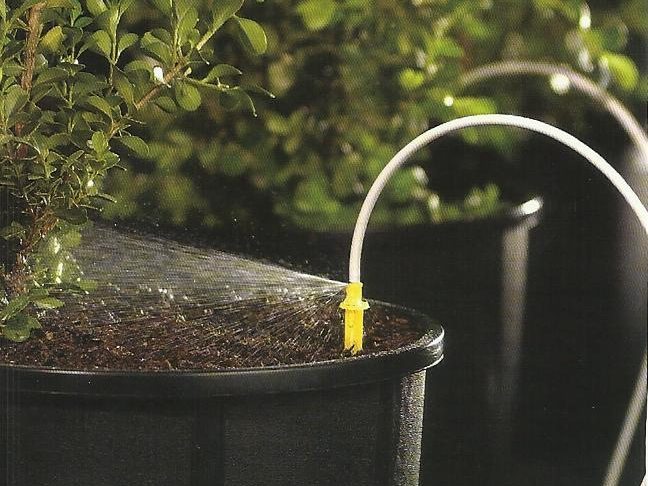
Spray stakes suit larger containers where the whole surface of the mix needs wetting. The Primerus Spot-Spitter is one stake per pot with no moving parts to clog; the Spot-Spitter Tall suits larger containers and deeper canopies, and the Spot-Spitter DownSpray keeps water off foliage. Netafim's PC Spray Stakes come in 3.2, 6.6, 7.9 and 10.6 gph, single or double spray, and hold flow to 60 psi; the non-PC 3, 5 and 7 gph stakes are the economical choice where zone pressure is already steady. Both are shaped to keep water on the mix rather than over the rim.
Smaller pots, where a spray would overshoot, take a pressure-compensating dripper on microtube. Netafim's Woodpecker PC runs 0.53, 1.06 or 2.25 gph; Dramm's PCAS emitters run 2 to 12 lph on 0.191" tubing, and a Dramm 4 Way Manifold splits one dripper across four pots. That is the point of a multi-outlet assembly: Netafim's Flat 4-Way Multi-Outlet Dripper Assembly puts one 2.11 gph WPC Jr. dripper on four tubes of 18" to 36", and Maxijet's spider assemblies feed a bed of pots from one take-off, with a hole in the 13" stakes that grips crimped vinyl to shut off a single pot. Antelco's Asta Drip Spike PC is emitter and spike in one part. Where a bed holds mixed sizes, Antelco's adjustable Shrubbler dials a plant up or down without swapping emitters, and the Shrubbler 360° PC adds pressure compensation for long runs and uneven ground. For large containers, a Dramm Pressure Compensated Dribble Ring held by an Anchor Stake spreads water around the mix. The spray stakes and emitters category lists all of these.
Beds of small pots and liners, where a stake per pot is not worth the labor, run on dripline laid down the bed. Netafim's Space-It is a thin-wall tape made for this: every dripper is marked on the tubing so pots line up under it, at 12" to 24" spacings and 0.2 or 0.4 gph. It is 8 mil and limited to 12 psi, so it must be regulated; the DripNet PC Thinwall is the pressure-compensating alternative for long or sloping beds. Permanent beds take a heavy-wall PC line such as Netafim DripNet PC Heavywall or Rivulis Hydro PC / PCND, whose PCND build allows pulse irrigation.
Hanging baskets come off drop assemblies from the overhead lateral. Netafim's Hanging Assembly (0300HSAC) drops a sprinkler, mister or fogger head on weighted white tubing in lengths from 12" to 48", and Hunter's Senninger Drop Adapter Assemblies mount the inverted Micro-Sprinkler or mini-Wobbler the same way.
What runs the valves depends on where the power is. Hunter names the Pro-C for nurseries, and it can be wired conventionally, on EZ Decoder two-wire, or both, which helps when an old block is being extended. Galcon's GALPRO Series handles 4 or 8 valves with proportional fertigation and a filter wash program built in. An outlying pad with no power runs on a battery controller such as the Bermad BIC or Galcon 6100 Series with DC latching valves like the Bermad IR-210. Have the pad layout, container sizes and water source to hand, ask us about zoning, and request a quote when you are ready.
20 of the lines that go into this kind of system, from the categories linked below. Each category page lists every model we carry.
Spray Stakes & Emitters·Multi-Outlet Drippers (MODS)·Hanging Basket Assemblies·Dripline·Drip Tape·Poly Tubing·Filtration·Fertilizer Injectors·Chlorination·Pressure Reducing Valves·Pressure Regulators·AC Solenoid Valves·DC Latching Solenoid Valves·AC Irrigation Controllers·DC & Battery Irrigation Controllers
Spray stakes suit larger containers where the whole surface of the mix should be wetted and a spray will stay inside the rim; the Netafim and Primerus stakes are shaped for that. Smaller pots take a pressure-compensating dripper on microtube, often as one leg of a multi-outlet assembly so one dripper serves several pots. Keep the two on separate zones, since their flows and run times differ.
Not always, but a pad is rarely as level as it looks, and friction loss along a long lateral drops pressure even on flat ground. Non-PC spray stakes and drippers are the economical choice on short, regulated laterals. On long runs, slopes, or anywhere you cannot hold pressure within the emitter's window, PC emitters keep the first and last pot on the line receiving the same water.
Small orifices need fine filtration: Netafim recommends 120 mesh for its Woodpecker and Button drippers and the Hunter HY Series zone filter carries a 150-mesh screen. Pond water carries algae and organic load, which disc filters handle better than screens, so a disc filter at the head with a screen filter at each zone valve is the usual layout. Flush laterals regularly, or fit automatic lateral flush valves at the ends.
Yes. A battery controller such as the Bermad BIC (two AA batteries, up to three years) or the Galcon 6100 Series (IP 68, one to six valves) runs DC latching solenoid valves like the Bermad IR-210 in the 3/4" and 1" sizes most nursery zones use. The valves need the same filtration and pressure regulation as a wired block; only the control changes.
Planning a container nursery irrigation: spray stakes, pc drippers and dripline for potted stock system? Send the crop, water source, pressure or pump size and the number of pots, benches or acres, and we'll come back with a material list and wholesale pricing within one business day.