ML Irrigation / Applications / Propagation Mist and Fog Systems for Cuttings, Plugs and Seedlings

Application

Propagation Mist and Fog Systems for Cuttings, Plugs and Seedlings

A propagation mist system keeps unrooted cuttings, seed plugs and young seedlings from drying out until they have roots. Fine mist or fog goes on in short bursts, many times an hour, to hold a film of water on the leaf and keep humidity high at the bench without soaking the media. The same hardware, run on a different schedule, raises humidity and pulls temperature down across a whole house.

The system is small in flow but unforgiving in detail. Nozzles with orifices this fine need clean water and steady pressure, valves that will open and seal on a zone drawing a few gallons an hour, and a controller that thinks in seconds rather than minutes. This page covers each part in the order you would design it, using the product lines in the ML Irrigation catalog.

Request a quote for this systemCall (864) 862-5000

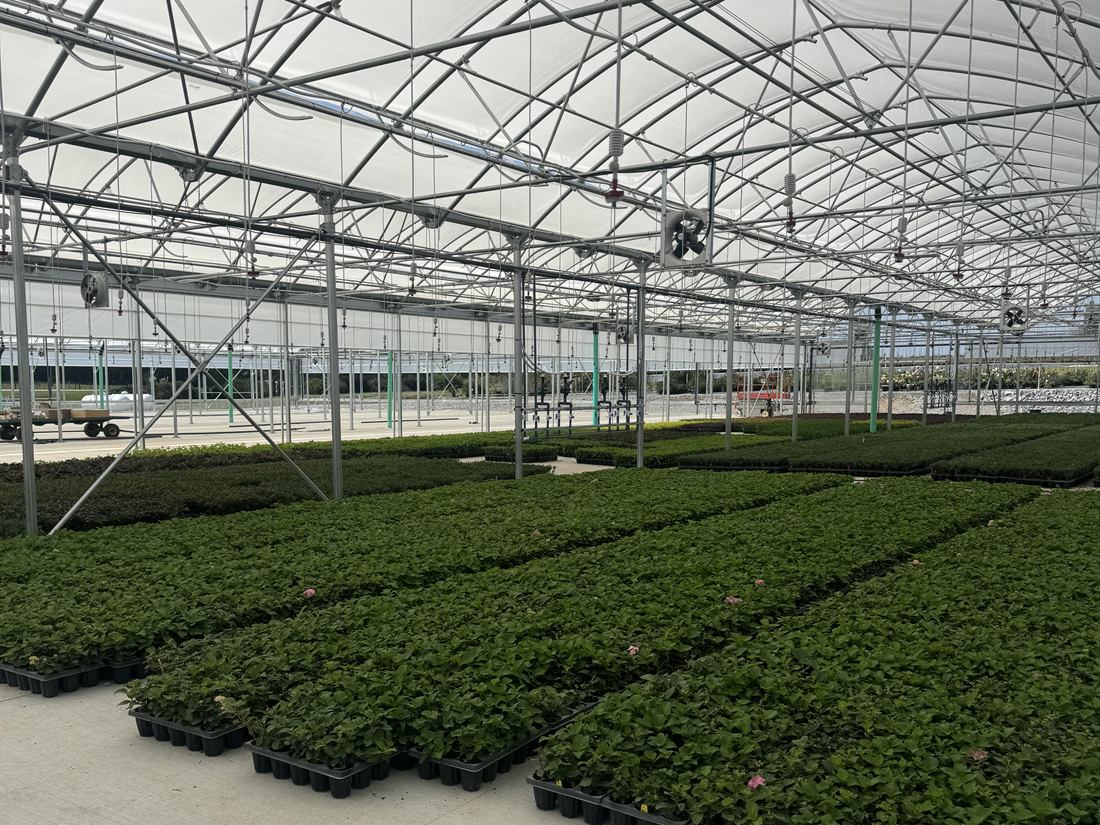
Overhead misting lines with emitters spaced along the trusses of a gutter-connect greenhouse, above rows of young plants in trays

Water source and filtration

Start with the water, because the nozzle decides how clean it has to be. A propagation fogger throws droplets measured in tens of microns: Netafim rates the CoolNet Pro at a 65 micron average, and Rivulis rates its Fogger at 55 microns at 60 psi. Orifices that fine plug on grit a drip emitter would pass without noticing.

Every mist nozzle carries a filtration rating, and the finest nozzle on the system sets the filter for the whole system. Rivulis calls for 120 mesh on the Fogger and Super Fogger, 100 mesh on Green Mist and 80 mesh on the Rondo Mist Sprayer. Check the rating before you order the filter.

The source matters as much as the mesh number. Well water usually needs a screen or disc filter sized for sand. Pond and surface water carry algae and organic matter that mat a screen quickly; grooved disc filtration holds that material far better, and an automatic unit like the Amiad Spin Klin Compact Angle 2 inch is sized for a single greenhouse or propagation house at up to 66 gpm, with disc grades from 20 to 400 micron. On a system that fires dozens of times a day, a filter that has to be opened by hand becomes the job nobody does. The filtration range covers both.

Opaque white tubing such as Netafim Bright White Polyethylene (PE) Tubing resists algae inside the line and runs cooler than black under glass, which is why it is the usual bench lateral. And if fertilizer or chlorine is injected through the same header, put the filter downstream of the injection point so precipitate is caught before the nozzles.

Pressure, valves and zoning

Mist nozzles are sold for a pressure window, narrower than most growers expect. Bench misters and low-pressure foggers sit in the 30 to 50 psi band: Senninger misters and foggers, Rivulis Green Mist, and Netafim CoolNet Pro and VibroNet at a 30 psi average. The fine-droplet foggers want more. The Rivulis Fogger makes its 55 micron droplet at 60 psi, and the Super Fogger comes in 40 psi medium-pressure and 60 psi high-pressure builds. Below the window a nozzle dribbles large drops; above it the pattern breaks up and fittings weep.

So keep one pressure family per zone and regulate every zone. The Netafim Series 80 Nylon pressure reducing valve is built for greenhouse and mist service, with three spring ranges covering 7 to 90 psi. Check the lateral too: Bright White PE is rated 44 to 66 psi by size, so a 60 psi fogger zone belongs on PVC or heavier pipe rather than thin bench tubing.

The zone valve is the part most often got wrong. A propagation zone may draw only a few gallons a minute, and a conventional diaphragm valve needs a minimum flow to seat; below it the valve chatters or hangs open. Use a low-flow solenoid valve: the Superior SPVLF has no minimum flow requirement, and the 3/4 inch Netafim Series 80 Nylon 2-Way Electric opens at a hundredth of a gallon a minute.

Fit anti-drain devices so laterals stay full between bursts. The Rivulis Super LPD holds the line pressurized and closes at 9, 22 or 35 psi by build; CoolNet Pro carries its own low-pressure check valve. Without them every cycle opens with drainage onto the trays below.

Choosing the nozzle: misters, mist sprayers and foggers

Droplet size decides what lands on the crop. A mister throws a droplet large enough to fall and wet the leaf and media surface; a fogger throws one small enough to hang in the air and raise humidity while foliage stays close to dry. Rivulis puts numbers on both ends: the Rondo Mist Sprayer at 150 microns, the Fogger at 55.

For cuttings and seed that root or germinate under a wet leaf, use a mister. The Rondo Mist Sprayer is the Rivulis germination and cutting nozzle: a 6.5 ft wetting pattern at 12.4 or 16.1 gph. Green Mist is their bench nozzle, mounted 3 to 4 ft above the bench with heads no more than 2.5 ft apart on laterals 3 ft apart. Netafim's VibroNet covers 4 to 5 ft benches on 3 ft spacing, with a blue nozzle for lighter mist than the 9.2 gph green. Senninger misters come upright for benches and inverted for drop assemblies over trays.

Where you want saturated air rather than wet media, or humidity and cooling across a bay, use a fogger. Netafim calls CoolNet Pro its best propagation nozzle for that reason, in 1.5 to 3.7 gph singles and an 8.1 gph four-nozzle head. For cooling and humidifying, the Rivulis Fogger is laid out four on a cross or two on a T, heads 6 to 10 ft apart. Senninger foggers are built for consistent start-up on short cycles, and Dramm's JetFog and Misty Mist nozzles thread into rigid pipe or push onto tube.

Browse the misters and foggers range, and hang one lateral first: run it, watch the pattern at bench height, then copy the spacing that works.

Control: seconds, intervals and sensors

A landscape timer runs in minutes; a mist bench runs in seconds. A typical propagation cycle is a burst of a few seconds every few minutes through the day, changing with light and as roots form, and a controller that cannot express that cannot run the bench. Look for a seconds time base and an independent interval on every station.

Dramm's MistTime is the purpose-built box: ten outputs, each on its own cycle with a duration from 1 second to 60 minutes and an interval from 1 minute to 12 hours, run continuously, between set times, or when temperature passes a set point, so the same unit can run cooling fog. It can also turn its last output into a pump pre-start so the system is at pressure before a valve opens. The MicroGrow Water Max gives twelve stations, each usable for mist or irrigation, with propagation mist on its own start, stop and cycle times and a separate night setting. Superior's Sterling Series suits a panel that also runs the rest of the nursery: station times from 1 second to 24 minutes, repeating cycles, and a pause between stations so one valve closes before the next opens.

Where the crop justifies it, MicroGrow's Water Pro VPD replaces the clock with a sensor that reads air temperature, humidity and a simulated leaf temperature, and opens the valve on vapor pressure deficit. Programs step as the root system develops, and night watering can be disabled.

See the controllers range, then request a quote with your bench count, house size and water source, or ask us which controller and valve family fits your benches.

Products we stock for this system

20 of the lines that go into this kind of system, from the categories linked below. Each category page lists every model we carry.

Misters & Foggers 11

CoolNet Pro

Mister & fogger
Flow
8.1 gph (4-nozzle assembly, model 0303420LL-B); single nozzles 1.5, 2.0 & 3.7 gph
Pressure
30 psi average working pressure
Best for
Best nozzle for propagation — creates a zone of saturated humidity ideal for rooting. 65 micron average droplet. Low-pressure check valve

VibroNet

Mister & fogger
Flow
9.2 gph (green nozzle) at 32 psi; blue nozzle for light mist
Pressure
30 psi average working pressure
Throw diameter
3 ft sprinkler spacing on 4–5 ft benches, 2–5 ft above crop
Best for
Light mist over larger areas — bench and single-bay watering. Blue or green nozzle with check valve (VN-BL / VN-GN)

Fogger

Mister & fogger
Flow
Broad range of nozzle flow rates for different precipitation rates
Pressure
High-pressure Super LPD 60 psi; medium-pressure Super LPD opens 44 psi, closes 22 psi
Connection
PE and PVC connections; T or cross manifold assemblies
Best for
Cooling, humidifying and propagation. Extra-fine 55 micron droplets at 60 psi (69 micron on the medium-pressure LPD at 45 psi). Leakage prevention device gives simultaneous start-up and shut-down across the block. For cooling and humidifying run 4 foggers on a cross or 2 on a T — laterals 9.8–13.5 ft apart, heads 6–10 ft; add pesticide spraying and it is 2 on a T only, laterals 6–10 ft, heads 4–5 ft. 120 mesh filtration

Super Fogger

Mister & fogger
Flow
Medium pressure 1.5 / 3.0 / 5.5 gph at 40 psi; high pressure 6.5 / 13 / 24 gph at 60 psi
Pressure
Medium (green cover) 40 psi, max 45 psi; high (blue cover) 60 psi
Connection
Multi-connection for PE pipe, or 3/8" thread for PVC
Sizes
1, 2 or 4 outlets
Best for
Greenhouse cooling, humidification and chemical application. Built-in leakage prevention device — medium-pressure model opens at 45 psi and closes at 20, high-pressure opens at 60 and closes at 35. Droplets average 2.7 mil medium / 2.1 mil high, so foliage stays dry under pulsed operation. Built-in filter. Climate control spacing 5x10 to 10x10 ft; pesticide spraying 5x10 ft; poultry 5–10 ft. 120 mesh filtration

Rondo Mist Sprayer

Mister & fogger
Flow
12.4 gph (black) and 16.1 gph (blue) at 44 psi
Pressure
36–58 psi
Connection
Ultra Conic inlet; assemblies with anti-leak valve, 12" tube, weight and coupling
Throw diameter
6.5 ft average wetting diameter
Best for
Seed germination and cutting propagation — 150 micron droplets fall gently over the seed instead of the large drops a conventional spinner throws, in a uniform pattern averaging 6.5 ft. Use the standard anti-leak model below 51 psi and the H model above it. Add a 4x7 mm grommet to the mini valve for insertion into PVC laterals. 80 mesh filtration

Green Mist

Mister & fogger
Flow
7.9–10.6 gph (7.9 at 29 psi, 9.0 at 36, 9.8 at 44, 10.6 at 50)
Pressure
30–50 psi
Connection
Taper lock female with low-pressure Super LPD 4/7 (black)
Throw diameter
4 ft
Best for
Misting and irrigation over propagation benches. Droplet size is tuned to stop mist drift, and distribution is symmetrical with no dead corners. Low-pressure LPD gives clean pulsed operation. Mount 3–4 ft above the bench, max 2.5 ft between heads on the lateral, 3 ft between laterals, and keep laterals within 10" of the bench edge. 100 mesh filtration

Senninger Fogger

Mister & fogger
Flow
6.8–23.4 gph
Pressure
30–50 psi
Best for
Propagation and low-volume misting; consistent start-up with highly uniform distribution for short-cycle work

Senninger Mister (Upright)

Mister & fogger
Flow
7.5–23.4 gph
Pressure
30–50 psi
Best for
Propagation benches and humidity control; colour-coded nozzles

Senninger Mister (Inverted)

Mister & fogger
Flow
7.5–23.4 gph
Pressure
30–50 psi
Best for
Overhead propagation and misting from drop assemblies

JetFog Barbed Nozzle

Mister & fogger
Sizes
Item JFSB · Sizes -
Best for
JetFog low-pressure fog nozzle with a barbed inlet, for pushing straight onto tube. Item JFSB — order JFST instead if the line is threaded.

Misty Mist Nozzle

Mister & fogger
Sizes
Item MM-RW, MM-KW · Sizes 1.25 mm, 1.50 mm · Colors Red / White, Black / White

Accessories & Spare Parts 1

Super LPD

Accessory
Pressure
Low-pressure opens 20 psi / closes 9 psi; medium-pressure opens 44 / closes 22; high-pressure opens 58 / closes 35
Connection
Barb 4/7, female, or 3/8" thread; bayonet x bayonet on the low-pressure model for Super Green Spin
Best for
Anti-drain valve, not an emitter — it stops drainage through the heads at shut-off and holds the system full and pressurised so the next cycle starts instantly. Minimal pressure loss even at high flow, one-stage open-or-shut action, easy-dismantle for cleaning. Three builds: black low-pressure for micro-sprinklers, green medium-pressure and blue high-pressure for foggers. Compatible with all Rivulis micro-sprinklers

Poly Tubing 1

Bright White Polyethylene (PE) Tubing

Poly tubing
Diameter
0.520", 0.600", 0.700", 0.820", 1.060" ID (0.620"–1.200" OD)
Wall
.050"–.070"
Pressure
44–66 psi (by size)
Coil lengths
100', 500' & 1,000'
Sizes
5 diameters, 13.2×15.8 mm to 26.9×30.5 mm
Best for
Greenhouse benches and propagation — opaque white resists algae, withstands heat and chemicals, and runs cooler than black

Filtration 1

Spin Klin Compact Angle 2"

Filtration
Flow
Up to 66 gpm (15 m³/h)
Pressure
Filtration 20–400 micron
Sizes
2"
Best for
The smallest automatic Spin Klin — one 2" unit for a single greenhouse or a propagation house. Polymeric grooved discs give depth filtration with high dirt-holding capacity and hold organic matter far better than a screen

Pressure Reducing Valves 1

Series 80 Nylon (Pressure Reducing)

Pressure reducing
Pressure
7–150 psi; spring ranges 7–30 psi (yellow), 14–65 psi (green), 30–90 psi (red); max water 140°F
Connection
Nylon threaded; all pilots and solenoids assemble on the bonnet — no tubes run to the valve body
Sizes
1½" & 2" — globe or angle
Best for
Pressure regulation for small blocks, greenhouse and nursery including hydroponic and mist systems. Three colour-coded spring ranges cover 7 to 90 psi. Clog-free labyrinth inlet for the command water makes it usable on dirty water. Quick to react and seals drip-tight. Order codes PRTH, or PRELTH for the pressure reducing electric version

AC Solenoid Valves 2

SPVLF Low Flow Plastic Valve

AC solenoid valve
Flow
0 to 200 gpm — no minimum flow requirement, reliable operation down to 0.01 gph
Pressure
20–200 psi, to 150°F. Standard 24 V ac; 110 V ac and 220 V ac optional
Sizes
1" (SPVLF100), 1½" (SPVLF150), 2" (SPVLF200)
Best for
The valve to reach for on mist and propagation zones. A dual-chamber design with a patented internal 3-way solenoid means it opens and closes regardless of system flow rate — there is no minimum flow to satisfy, so it will hold a zone drawing almost nothing, where a conventional diaphragm valve chatters or fails to seat. Glass-filled nylon body, EPDM diaphragm, coil rotates 360° and lifts off without disturbing the solenoid operator. Five-year warranty

Series 80 Nylon 2-Way Electric

AC solenoid valve
Flow
3/4" 0.01–26 gpm · 1" 0.01–44 gpm · 1½" 0.25–110 gpm · 2" 0.25–176 gpm
Pressure
7–150 psi; max water 140°F
Connection
Nylon threaded; glass-reinforced polyamide body, bonnet and diaphragm seat, SST 304 fasteners, SST 302 spring. 24 VDC, 12 VDC, 12 VDC latching or 120 VAC
Sizes
3/4", 1", 1½", 2" — 3/4" and 1" globe; 1½" and 2" globe or angle
Best for
The small greenhouse and nursery valve — the 3/4" opens at a hundredth of a gallon a minute, so it will run a mist or hydroponic zone that a bigger valve cannot see. Exceptionally low inrush and holding current gives the longest wire run from valve to controller. No-diode solenoid, stable against voltage fluctuation and insensitive to dirt. Integrated check valve on 1½" and 2" keeps the valve shut until the controller calls for it. Optimal vertically. Flow-control stem gives manual control from full closure to full capacity

AC Irrigation Controllers 3

MistTime Misting Controller

AC Controller
Sizes
Item MT-10 · Sizes 10 Output · Colors -
Best for
The Dramm MistTime Controller is perfect for time or temperature based control of misting valves. With the ability to program each valve independently, the MistTime offers unmatched flexibility. Each valve is operated on a cycle. The timing is variable with the duration operating between 1 second and 60 minutes and the interval time operating between 1 minute and 12 hours. Each valve can be run continuously, between specific times, or even started when the temperature rises above a set point. With the ability to program each valve independently, the controller can operate as a time based mist controller, a pulse-irrigation controller and a mist cooling controller at the same time. In addition, the MistTime offers the option to convert the last valve output to a pump pre-start output. When configured in this manner, the operator is given an option to pre-start a pump prior to any valve operation. The pre-start time is variable. This ensures that the system is properly pressurized when the mist system is in operation. The MistTime is easy to program using a keypad to navigate the menu and enter amounts. For flexibility, the MistTime can be programmed in English, Spanish, French or Dutch. The MistTime operates on 120vAC or 220vAC and includes a 24vAC output. The unit is enclosed in a NEMA 4 rated PVC housing and is easy to wire and install.

Water Max

AC Controller
Connection
24 VAC in and out; output switches centre-off / automatic / manual; lighted output indicators
Sizes
12 independent stations; 24-hour on-board digital clock
Best for
Twelve stations each set individually for run time, watering days and repeats up to four times a day, and each usable for misting or irrigation. Propagation mist has its own start and stop times plus on/off cycle times, and night misting adjusts separately. Alternate-day watering — every day, every other day or every third day

Sterling Series Controller

AC Controller
Connection
Input 120 V ac 50/60 Hz; output 24 V ac 50 VA. Two 4-watt solenoids per station; up to six solenoids at once below 0.25 A each. Non-volatile memory holds programmes through any outage; a ten-year lithium battery keeps real time
Sizes
4, 8, 12, 18, 24, 30 and 36 stations. Wall or pedestal mount — pedestal sold separately. Terminal strip option (TS) on the 18, 24, 30 and 36
Best for
The reason to specify this over a landscape timer is the time base: all six programmes can switch to seconds, giving station times from 1 second to 24 minutes in 1-second steps, with misting cycles that repeat immediately or after a delay of 1 minute to 4 hours 15 minutes. A programmable 1–59 second pause between stations lets a valve close fully before the next opens. Six independent programmes run concurrently, any station can sit in all six, and programme 6 can be triggered by a thermostat or sensor switch for frost protection or cooling. Water budgeting 1–255%, rain-off to 14 days, weather-proof locking steel cabinet

Categories for this application

Misters & Foggers·AC Solenoid Valves·AC Irrigation Controllers·Filtration·Pressure Reducing Valves·Poly Tubing

Frequently asked

Should I use misters or foggers for rooting cuttings?

Misters put a droplet on the leaf and wet the media surface, which is how most cuttings and seed flats are propagated. Foggers make a droplet fine enough to hang in the air, raising humidity while foliage stays nearly dry, which suits crops that rot under leaf wetness and doubles as cooling. Many houses run both: fog for humidity, mist on the benches that need it.

What pressure and filtration does a propagation mist system need?

It depends on the nozzle. Bench misters and low-pressure foggers in our range run around 30 to 50 psi; fine-droplet foggers run at 60 psi and above. Filtration ratings run from 80 to 150 mesh depending on the nozzle, and the finest nozzle sets the filter for the system. Surface water with algae is better handled by disc filtration than by a screen.

Why does the solenoid valve chatter or stay open on my mist zone?

Most diaphragm valves need a minimum flow to close properly, and a mist zone drawing a few gallons a minute may not reach it, so the valve hunts or never seats. Fit a valve rated for low flow, such as the Superior SPVLF, which has no minimum flow requirement, or the 3/4 inch Netafim Series 80 Nylon 2-Way Electric, which opens at a hundredth of a gallon a minute.

Can my existing irrigation controller run a mist bench?

Only if it has a seconds time base and a repeat interval on the station. Most landscape timers count in minutes, which is far too long for cuttings. Controllers such as the Dramm MistTime, MicroGrow Water Max and Superior Sterling Series are built with seconds-long run times and minute-long intervals, and the MistTime can also start a pump ahead of the valve.

Planning a propagation mist and fog systems for cuttings, plugs and seedlings system? Send the crop, water source, pressure or pump size and the number of pots, benches or acres, and we'll come back with a material list and wholesale pricing within one business day.

Request a quoteCall (864) 862-5000