Water source and filtration
Most pot-in-pot blocks pump from a pond or a well. Pond water carries algae and organic debris; well water can carry sand and precipitated minerals. Every emitter on this page has a small flow path or orifice, and the block is only as reliable as the filter ahead of it. Netafim recommends 120 mesh filtration for its Woodpecker Dripper (WP), and the Hunter HFR Filter Regulators carry a 150 mesh stainless steel screen, which gives a sense of how fine the primary filter needs to be.
As general practice, disc filtration suits the organic load in surface water, screen filtration suits cleaner well water, and a sand separator belongs ahead of the filter on a well that pumps grit. The primary filter comes from the filtration category; the Netafim 2" Compact LP Disc-Kleen is built for low-pressure spray stake and drip blocks that do not have the head to drive a conventional filter. On pond water with heavy algae, treating the water upstream of the filter is worth a conversation before the filter is sized.
Plan the flushing with the filter. Lateral ends need a flush point, and buried laterals need it more than surface ones because you cannot see what is collecting inside. A secondary filter at the zone, such as the HFR with its flush cap or the built-in screen on the 2" and 3" Toro P-220 Series Valves, catches what gets past the primary and what breaks loose from the mainline after a repair.
Pressure regulation and zoning by container size
A non-compensating spray stake pushes more water at higher pressure than at lower, so a lateral that loses pressure to friction and elevation waters the near pots harder than the far ones. Either regulate at the zone and keep laterals inside their run length, or specify pressure-compensating emitters. Netafim's Spray Stakes (Non-PC) figures show why flow matters: 3 gph reaches 215 ft on 0.520" pipe, 7 gph reaches 145 ft. The PC Spray Stakes hold flow to 60 psi and the Woodpecker PC (WPC) compensates from 7 to 58 psi, so long or sloping rows stay even.
At the zone, a valve that switches and regulates in one body saves parts: the Toro P-220 Series Valves regulate from 5 to 100 psi in 1" to 3", and the Netafim Series 80 Nylon covers 7 to 90 psi in 1½" and 2" with three color-coded spring ranges. Otherwise fit an inline unit from the pressure regulator category. Netafim's preset Pressure Regulators run 0.25 to 175 gpm with an indicator showing when outlet pressure is reached, and the Senninger PRLV both regulates and caps flow, so a burst lateral or an open end does not drain the block.
Zone by container size and crop, not pipe layout. One flow per stake and one run time per zone; a #7 and a #25 on the same valve means one of them is watered wrong. Laterals come from poly tubing: Netafim Black Polyethylene (PE) Tubing runs 0.400" to 1.060" ID at 46 to 75 psi, and Toro Blue Stripe Polyethylene Hose comes striped in blue, white or purple for zone identification, or in white to help control water temperature.
The emitter at each pot: spray stakes versus drippers
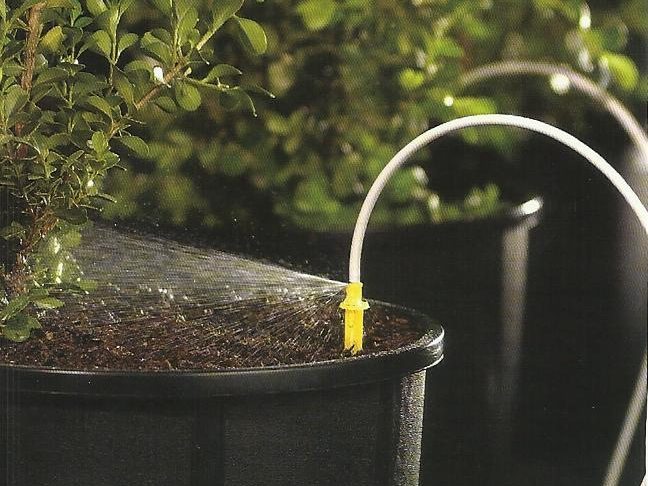
A spray stake wets the whole surface of the mix, which matters in bark-based media where a single drip point channels straight down. Netafim's PC Spray Stakes come in 3.2, 6.6, 7.9 and 10.6 gph on a 7" stake or a 12-gauge metal rod mount, single or double spray. The pattern angles downward to keep water on the mix, not over the rim, and compensates to 60 psi. The Spray Stakes (Non-PC) in 3, 5 and 7 gph are the economical choice where zone pressure is already steady. The Primerus Spot-Spitter takes the same one-stake-per-pot approach with no moving parts; the Spot-Spitter Tall suits larger containers and deeper canopies, and the Spot-Spitter DownSpray pattern keeps water off foliage.
Drippers suit sockets where overspray is a problem or lower flow per pot is wanted. Netafim's Woodpecker PC (WPC) delivers 0.53, 1.06 or 2.25 gph; the Woodpecker PC with CNL (WPC-CNL) seals once pressure drops below about 5 ft of head, so a sloping lateral does not empty into the bottom pots. The Rivulis Supertif PC / PCND does the same job with a side outlet, and the Antelco Asta Drip Spike PC builds the emitter into the spike. In a large container, use two drip points or a spray stake.
Multi-outlet assemblies feed several pots from one take-off. Netafim's Flat 4-Way Multi-Outlet Dripper Assembly runs one 2.11 gph WPC Jr. dripper to four pots on 18" to 36" tubes, and some of Maxijet's 13" stakes carry a hole that grips crimped vinyl to shut off one head, so a socket that just shipped comes out of service without cutting. See spray stakes and emitters and multi-outlet drippers.
Valves, control and getting the block sized
Every zone ends at a valve. AC solenoid valves run from a wired controller; on an outlying block with no power at the valve, a DC latching solenoid on a battery controller avoids the trench. Hunter's PGV Series is ordered with a DC latching solenoid for that reason, and its low-flow capability means it will drive a micro-irrigation zone rather than only sprinklers. Run time is set per zone, which is why zoning by container size comes first: no controller can fix a valve that serves two pot sizes.
A common failure we see is a block that was zoned by pipe layout years ago and has since been replanted with a different container size. The valve count did not change, the run times did, and the small pots drown while the large ones dry out. Fixing that is a valve and regulator job, not a controller job.
Sizing a block starts with pot sizes and counts per zone, row lengths, elevation change across the field, the water source and the pump's capacity. Those numbers are what flow per stake, lateral diameter and run length, regulator setting and filter size are worked out from. Request a quote with what you have, and ask us about anything you are not sure of.
20 of the lines that go into this kind of system, from the categories linked below. Each category page lists every model we carry.